

Content available exclusively for subscribers
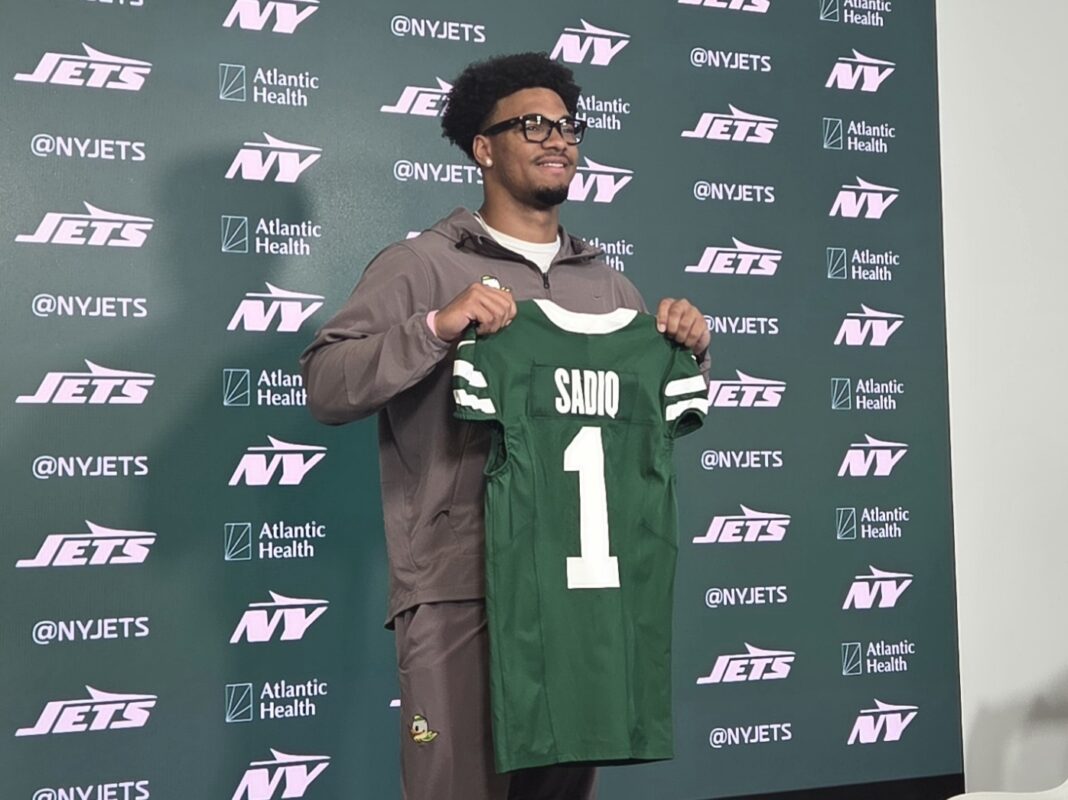
Tight end Kenyon Sadiq, whom the Jets picked 16th overall, prides himself on “not being a liability.”
He’s talking about his blocking as an undersized tight end.
He is not a small man by human standards at 6 ft 3 1⁄8 in and 241 pounds.
On Planet Earth, 6-3, 241 doesn’t constitute a small person.
But in the world of NFL tight ends, where the norm is usually in the 6-5, 250-260 range, he’s certainly on the smaller side.
And what you often see with “move” tight ends, as they are often called, they are often a little smaller than conventional tight ends, but that makes them appealing because they are often faster than the bigger guys at the position.
But with “move” tight ends or H-Backs, another name for them, that lack of ideal size that often makes them match nightmares for linebackers and safeties, because they run faster, not carrying as much weight, can also hurt them as blockers, not having as much “mass in the ass” to use an old scouting phrase.
An example is Denver Broncos tight end Evan Engram (6-3, 240), a first-round pick of the New York Giants in 2017.
With his 4.42 speed, he’s a matchup nightmare in coverage, but he’s not considered a very good in-line blocker.
But Sadiq seems to be a unicorn for an undersized tight end – he’s also a good blocker.
“I think, being an undersized tight end, a little bit, to be honest, not being a liability on first and second down, being able to do a little bit, because it also helps the team out too and helps myself out,” Sadiq said.
What is the key to Sadiq not being a liability as a blocker?
“Pad level and speed to contact, because obviously I’m not as tall as some of those guys or as big as some of those guys, so it’s using the little things that I have, whether that’s pad leverage or speed to contact.”
He also feels his “aggression” and “passion” for the game translate to his blocking.
“I’m going to have to clean some things up, but man I’m going to hit someone,” Sadiq said. “That’s one thing I’m not going to be scared to do: go hit somebody.”
Aaron Glenn feels that Sadiq not being a liability as a blocker will create strategic advantages for the Jets. So often, when a huge, blocking tight end is on the field, teams don’t consider him much of a threat in the passing game, and that can help their scheming for the player. Conversely, when a “move” tight end is on the field, defenses assume he’s going to go for a pass more times than not.
“Be able to force a defense to, ‘Ok, so what are you going to do now.’ And if you get into nickel, we get a chance to run the ball,” Glenn said. “You get them in base, then we get the chance to throw it. So, man, it’s going to be exciting to have him.”
Now, he’s not a finished product as a blocker, and will work with Jets tight end coach Alfredo Roberts to improve certain technical things.
So often with “move” tight ends, they would rather just catch the ball, and kind of go through the motions as a blocker. Scouts often describe this as just a “get in the way” blocker, but that isn’t Sadiq at all. He “put his face in the fan,” as they say in the football world.
And that will create strategic advantages for new Jets OC Frank Reich.
May 26, 2026
Premium will return by 9:30 pm (or sooner) on Wednesday.